Raw material sourcing by kg
Starch Sodium Octenylsuccinate
Specify the octenylsuccinate-modified starch identity and proposed preparation before comparing materials. Keep the sodium form, base starch and any additional treatment explicit in the supplier enquiry.
Explore Food Additives & Functional Food Ingredients
Define your ingredient input
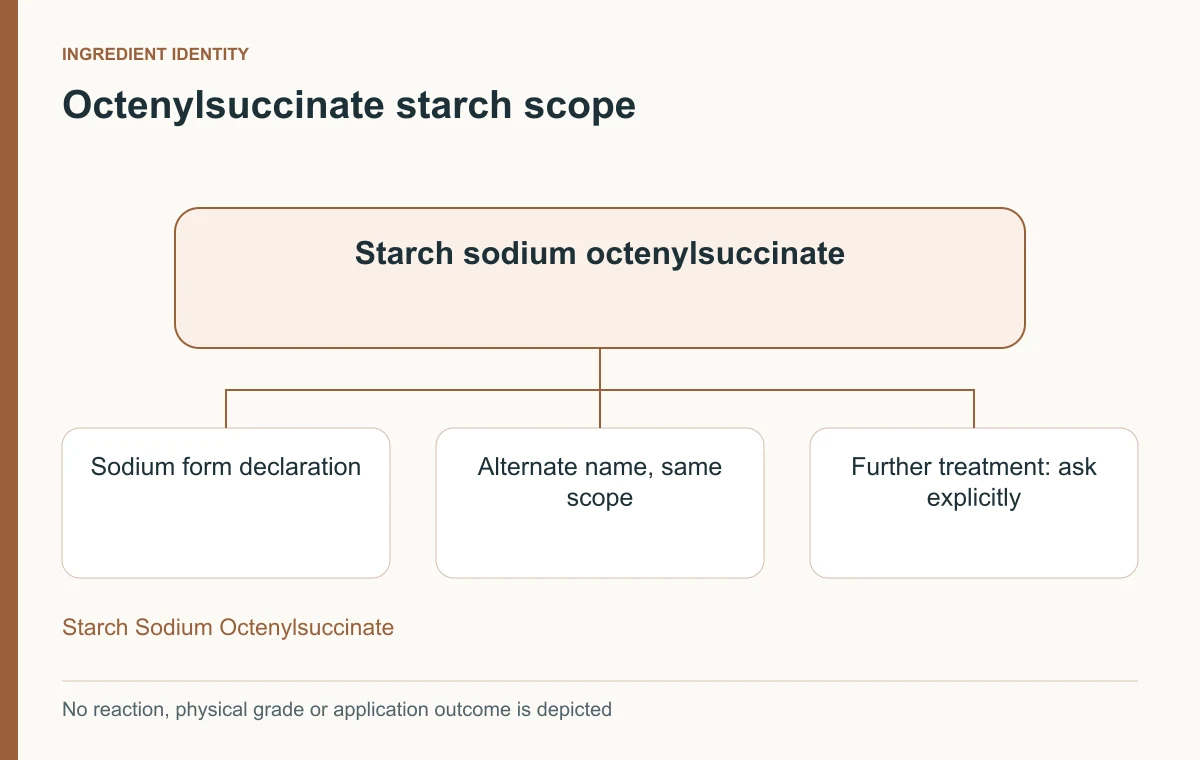
Request the octenylsuccinate modification and sodium form explicitly, with the base starch and complete preparation. Additional modification or further enzyme treatment must be declared rather than inferred. Alternate name order is not another material, and the name does not establish an application performance result or resistant-starch level.
Discuss your procurement requirements
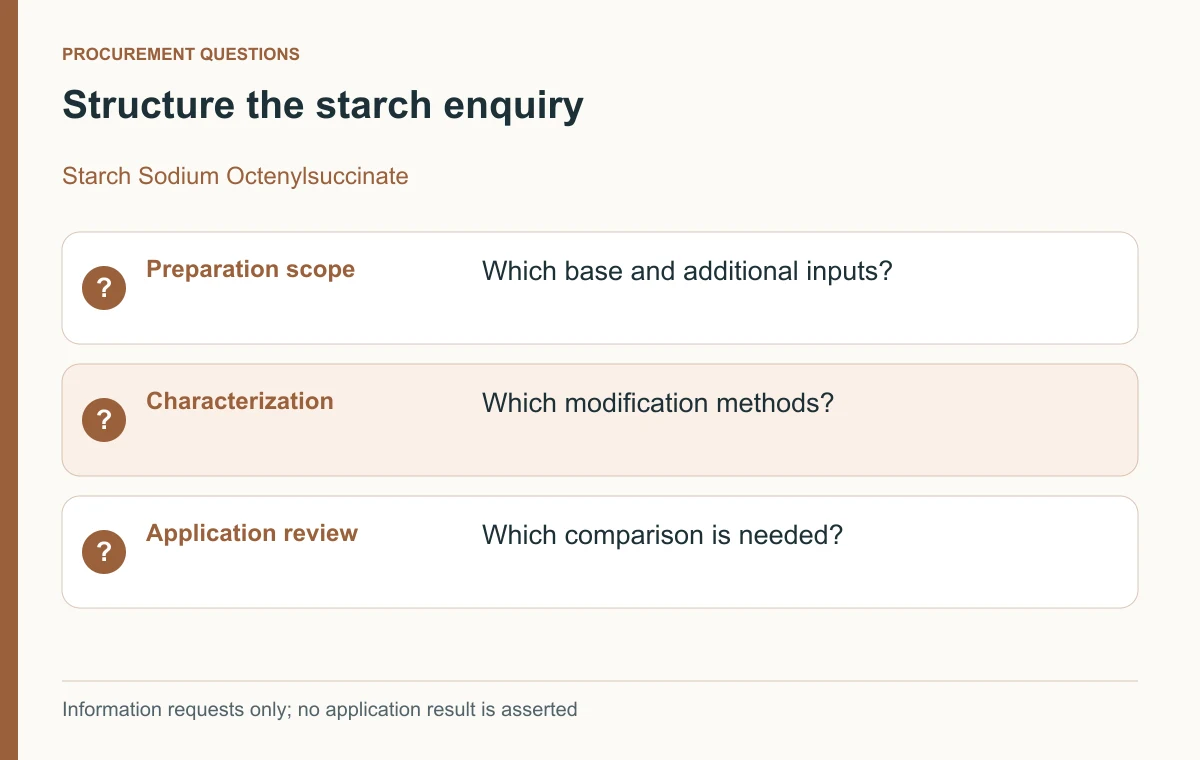
- How are the octenylsuccinate modification and sodium form stated?
- Which base starch, physical preparation and additional components are proposed?
- Is further enzyme treatment or another modification expressly declared?
- Which characterization methods and reporting basis support the modification identity?
- Which formulation-comparison questions should guide assessment without assuming performance?
- Which documents, sample reference and destination questions correspond to the proposal?
Other ingredient identity pages: Acetylated Distarch Adipate · Hydroxypropyl Distarch Phosphate · Distarch Phosphate
Confirm the offered specification, analytical methods, sample arrangements and documentation with the proposed supplier for your intended project.
Declared ingredient identity
- Starch Sodium Octenylsuccinate
Confirm the proposed grade, preparation inputs and specification with the supplier. This generic identity does not establish a supplied batch.
Clarify the material declaration
Ask how the proposal states the octenylsuccinate modification and sodium form together with the selected base starch. Does it include another modification, further enzyme treatment, carriers or other preparation inputs? Identify these explicitly rather than widening the scope silently. An umbrella modified-starch name does not describe the same sourcing input. Alternate word order in the product name does not establish a different material. Define the requested declaration without assuming a brand, process recipe, physical preparation or fixed grade.
Define the application comparison
Describe the intended formulation and the material-comparison questions that should guide discussion. Ask which physical-preparation, dispersion and handling information is relevant to the proposed sample. Discuss characterization methods specific to the declared modification and the reporting basis needed for comparison. Emulsion, stability and encapsulation expectations should be presented as project questions for assessment of the actual material, not assured outcomes of an unselected preparation. Neither the modification name nor a conceptual visual establishes technical performance, an application dose or resistant-starch content.
Keep documents aligned with the scope
Review the specification, complete composition declaration and sample identification together. Ask which source, allergen, analytical-method and destination-document questions apply to the project. The supplier should distinguish the proposal from further-treated or differently modified starches and confirm available supporting documents. Include quantity, packaging preference and timing after the identity requirements are clear. The name alone does not confirm commercial availability, food-grade status or destination-specific suitability, and a reference text is not a certificate for the proposed material.
Procurement questions and answers
Does Sodium Octenyl Succinate Starch describe another material?
It is alternate wording for the same sourcing identity here. Compare the complete declaration rather than relying on name order.
Are further-treated preparations automatically included?
No. Additional modification, enzyme treatment and blend inputs should be expressly declared and assessed for the project.
Does the name guarantee emulsification or encapsulation performance?
No. Define the intended application and comparison questions, then discuss assessment of the actual proposed material with the supplier.
Formulation and procurement gallery
Plan your purchase by kg
Share quantity in kg, intended formulation, destination and packaging requirements. Review the actual proposed material and purchase terms with the supplier.