Raw material sourcing by kg
Adipic Acid
Adipic acid is a named ingredient with food-use and industrial supply contexts. For a food project, specify the intended use and the actual proposed food ingredient documentation before comparing offers.
Explore Food Additives & Functional Food Ingredients
Define your ingredient input
The chemical name does not by itself identify a food-use supply. Keep an adipic acid sourcing request separate from industrial polymer inputs, adipates and other organic acids. Public food-grade manufacturer information and the named additive identity support a neutral procurement discussion; they do not establish a supplier's batch conformity or approval in a particular destination.
Discuss your procurement requirements
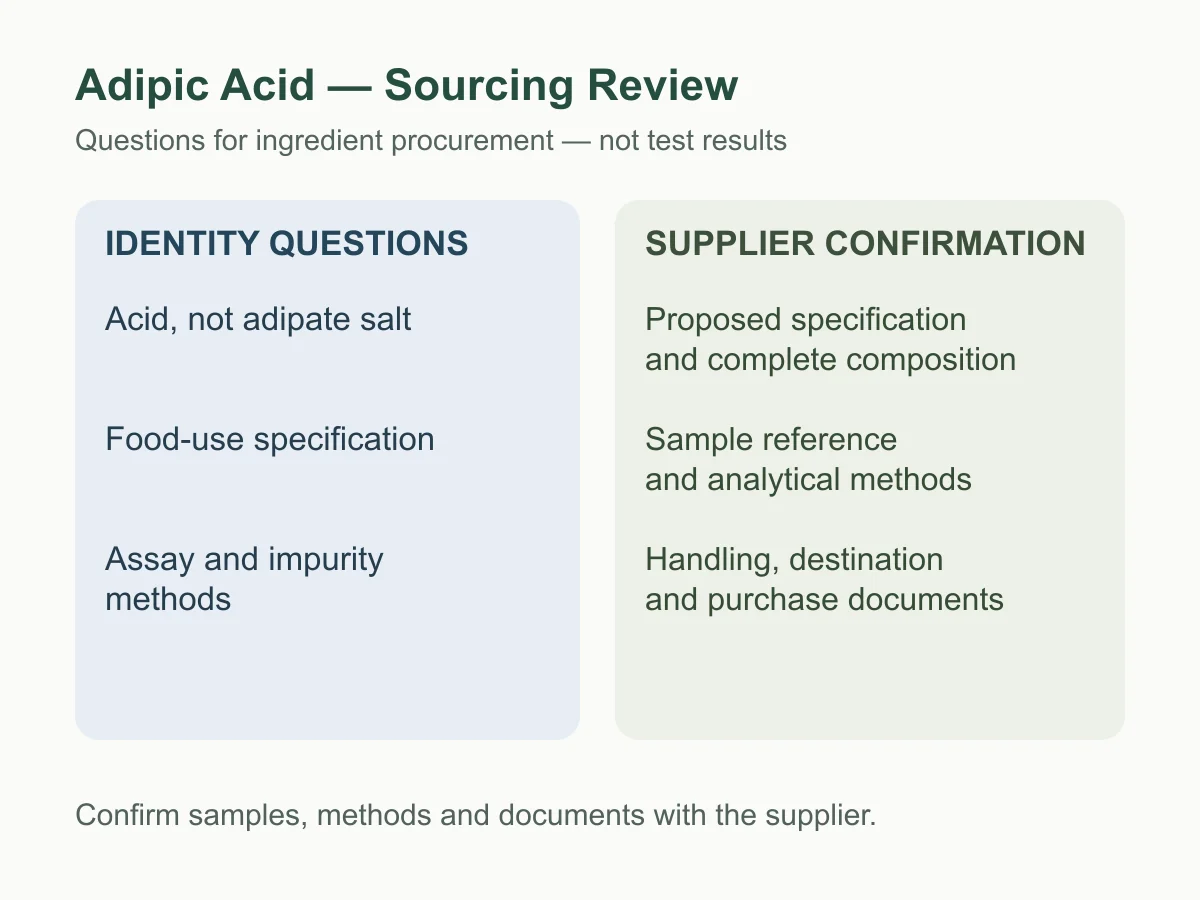
- Can the supplier confirm adipic acid identity and a specification intended for the proposed food application, rather than an industrial-only offer?
- How are assay, acidity and water content measured, expressed and reported for the actual material?
- What particle-size description, sampling method and dissolution conditions should be used to compare the proposed solids?
- Which impurities and residual-process information are covered by the specification, and what batch analytical methods support them?
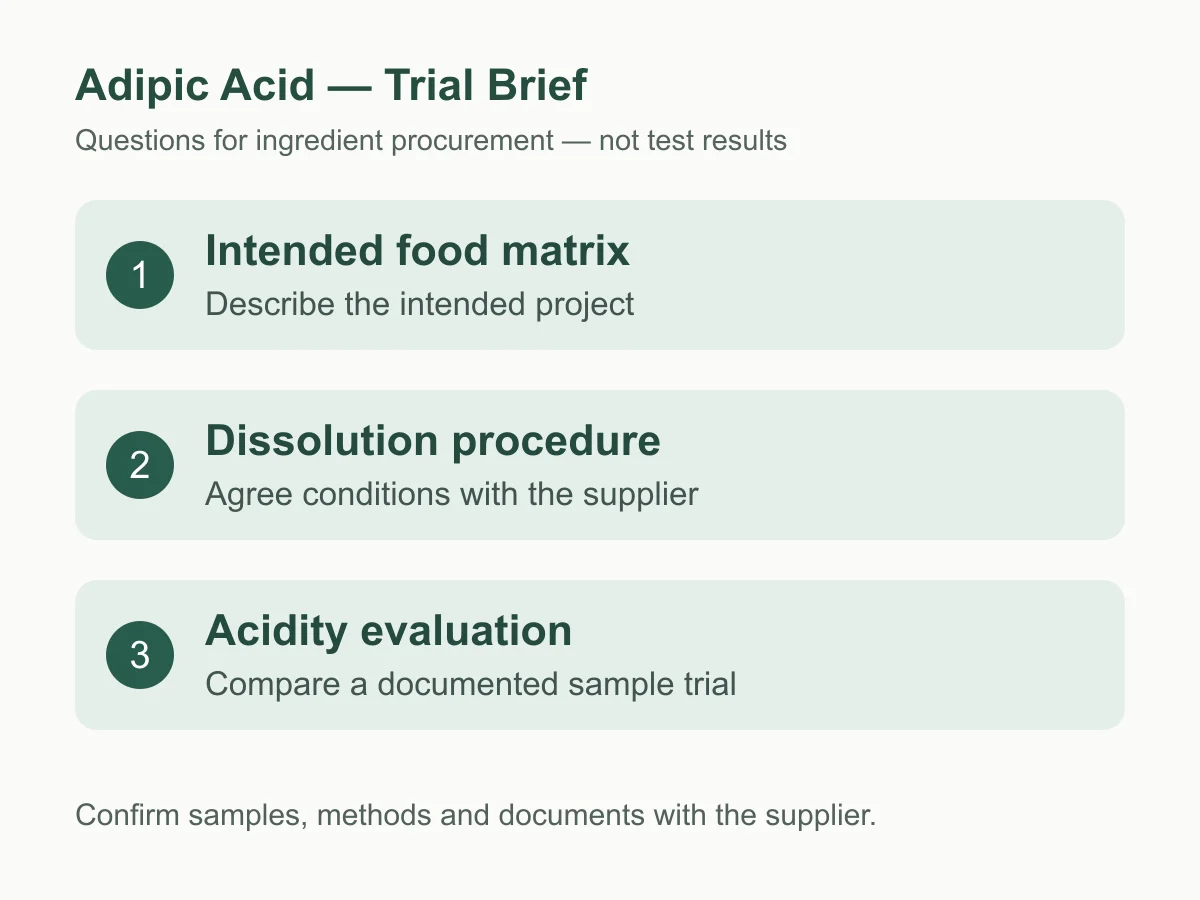
- What food matrix, processing conditions and acidity evaluation protocol should the supplier review for a sample trial?
- Can the supplier confirm sample handling, safety and storage information, packaging, kg quantity, destination documents and purchase terms?
Other ingredient identity pages: Disodium 5'-Inosinate · Succinic Acid · DATEM · Beta-Cyclodextrin · Gum Ghatti · Karaya Gum · Tragacanth Gum · Curdlan · Gamma-Cyclodextrin
Confirm the offered specification, analytical methods, sample arrangements and documentation with the proposed supplier for your intended project.
Separate chemical identity from supplied grade
Use the full name adipic acid in the request and state the intended food project. The same named chemical also appears in industrial supply chains, so an industrial description is not sufficient to establish a suitable offered food ingredient. Ask for the actual proposed specification and its intended scope. The existence of a published food-grade product elsewhere is not evidence that an unverified offer meets that specification.
Align acidity and physical-form comparisons
A useful comparison specifies the analytical basis for assay and acidity, the reported units and the relevant water information. Ask how particles are described and how the sample will be dissolved or incorporated into the target formulation. Agree the preparation conditions before interpreting results. This page does not assign a purity, solubility value, particle size or performance target to an actual supply.
Review the batch and destination documents
Request the batch analytical report, method references, handling guidance and storage recommendations for the proposed material. Share the intended food process and destination so the supplier can identify the relevant documents for review. Any application limits and market-specific requirements need an appropriate project review; the identity references here are not a market-approval statement. Sample and commercial arrangements remain subject to supplier confirmation.
Procurement questions and answers
Is any industrial adipic acid a food ingredient?
No. The chemical name alone does not establish the intended grade or documentation. Confirm the actual food-use proposal with the supplier.
Are adipate salts the same procurement object?
No. Specify the acid itself and review salts or derivatives separately.
Does a named additive reference establish destination approval?
No. It supports identity research only. Review the actual material and intended use with the appropriate documents.
Formulation and procurement gallery
Plan your purchase by kg
Share quantity in kg, intended formulation, destination and packaging requirements. Review the actual proposed material and purchase terms with the supplier.